


Posted on: 26th October 2026
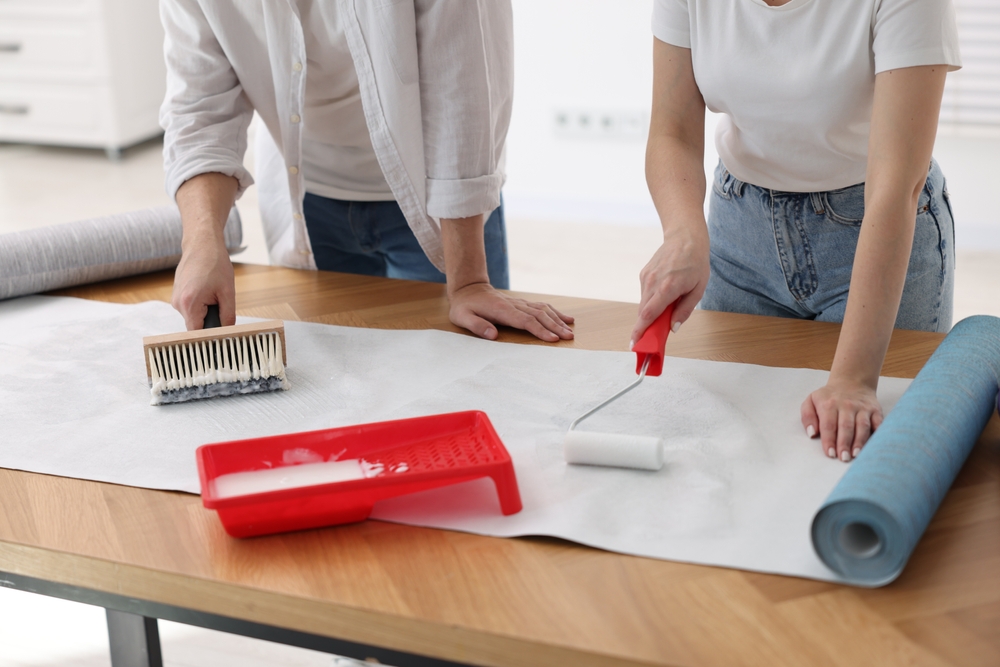
How to be a whiz at wallpapering - even if you are a novice!
For many, wallpapering can seem daunting and a big leap out of your comfort zone, however, forward planning, a few tips and some patience may be all you need.
A few housekeeping and safety rules before you start.
Keep wallpaper paste, cleaning products, scissors and knives out of children’s reach. Open windows and doors so the room stays well-ventilated while you apply the paste and while it dries.
If you are working near a stairwell, you may need some help handling long, heavy strips at height.
Let’s get started ….
1. Prepare the wall
Walls must be clean, dry, solid and smooth. Prime plaster, plasterboard or wood the day before. Lightly sand and prime gloss or silk paint; wash matt paint with a baking-soda cleaner and leave for 24 hours.
Tip: Lining paper hides minor unevenness and helps prevent gaps between strips.
2. Mark the wall
For 53 cm wallpaper, draw a vertical line 50 cm from the corner with a spirit level. Align the first strip to it; the 3 cm overlap can be trimmed neatly.
3. Cut the wallpaper to size
Cut the first strip once the wall is ready. Measure from ceiling to skirting board, add 100 mm for trimming, check the measurement, then cut.
4. Apply wallpaper paste
From the guideline, brush or roll a thin, even coat of paste over an area slightly wider than one strip, working downwards.
5. Hang the wallpaper
With the printed side facing you, align the roll to the guide and unroll towards the ceiling, leaving 2–3 cm extra at the top. Check alignment, then smooth from the centre outwards to remove bubbles and wrinkles. Paste-the-wallpaper can usually be repositioned: peel it back slowly, realign and smooth again.
Trim excess
Press a ruler or cutting guide into the ceiling edge and trim with a sharp wallpaper knife; repeat at the skirting board. Cut slowly, keeping fingers behind the blade. Flatten the join with a seam roller. Butt each remaining strip against the last without overlapping, matching any pattern before smoothing.
Wallpapering around difficult areas
Around sockets, doors or pipes, allow extra paper for trimming and make several small cuts rather than one large one.
Wallpapering around sockets & switches
Switch off electricity at the mains. Loosely cover the fitting, mark it, cut from the centre and trim outwards gradually. For a neat edge, loosen the faceplate, tuck paper behind it and refit.
Wallpapering around doors and windows
Overlap the opening, mark the corner and cut at 45 degrees towards it, leaving a few centimetres for trimming. Smooth paper around the frame, press it into the edge and trim the excess carefully.
Wallpapering around radiators
Remove the radiator only if you can do so safely; otherwise paper behind it. Measure to each fixing and add 2–3 cm for trimming, allowing extra for pattern matching. Mark the fixings, make small cuts, slide the paper behind the radiator and smooth it around them.
Wallpapering around pipes
Paste the wall, measure passed the pipe, mark its position and make the smallest cut needed. Ease the paper behind the pipe, smooth it flat and trim if needed.
Wallpapering a feature wall
Hang and smooth the final strip, press it into the corner crease, then use the crease as a guide to trim the excess.
However, if you feel that you don’t have the confidence or skill to carry out these or other home improvements, please contact our tried and tested tradespeople at www.safelocaltrades.com to avoid a DIY disaster.
 100% secure - we never share your email